
California’s promise vs. reality
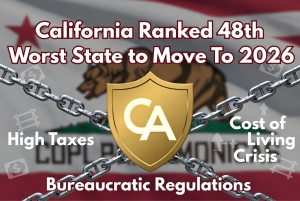
California: The Golden State’s Tarnished Promise – Why It’s Ranked Among the Worst Places to Move in 2026
A new report from Consumer Affairs has once again highlighted what many Californians already feel in their wallets and daily lives: the state ranks 48th out of 50 as one of the worst places to move to in 2026, sandwiched between Louisiana and New Mexico at the bottom.
This isn’t a surprise to residents battling sky-high costs, but it underscores a deeper issue driven by excessive government regulations, punitive taxes, and bureaucratic overreach that have made the California Dream increasingly unaffordable and unsustainable.
The Numbers Don’t Lie:
California’s Poor Performance
According to the ConsumerAffairs analysis, which evaluates affordability, safety, economic strength, healthcare, education, and quality of life, California scores a dismal 38.06 out of 100. It ranks dead last (50th) in affordability, 49th in safety (second-most dangerous state), and 41st in economic strength.
Housing and Cost of Living:
Typical housing costs eat up 21.1% of median income in California, far above the national 17.6% average.
Overall living costs run about 10.7% higher than the national average. Residents pay more for everyday goods, services, gas, and essentials.
Crime:
The state sees 4.9 violent crimes and 20.78 property crimes per 1,000 residents—well above national averages of 3.6 and 17.6.
Economy:
Unemployment exceeds the national 4.2% average, and businesses continue to face headwinds.
These metrics reflect years of policy choices that prioritize regulation and spending over practical governance.
Root Causes:
Taxes, Regulations, and Government Overreach
California’s challenges stem directly from layers of government intervention:
1. Punitive Taxation
California boasts one of the highest overall tax burdens in the U.S. High state income taxes (top marginal rates among the highest nationally), sales taxes, gas taxes (already pushing prices significantly above the national average), and property taxes (despite Prop 13 protections for long-time owners, new buyers face steep reassessments) squeeze families and businesses.
Proposed measures like wealth taxes or additional hikes only accelerate the flight of residents and jobs.
Reason 2. Burdensome Regulations
Strict environmental rules, zoning restrictions, labor mandates, and permitting processes inflate housing costs dramatically by limiting supply. Energy regulations drive up electricity and fuel prices. Businesses cite red tape as a major reason for relocating headquarters or operations to states with lighter footprints. This overregulation stifles economic growth, raises costs for consumers, and contributes to the housing shortage that pricing out middle-class families.
Reason 3. Spending and Overreach
Massive state budgets—often exceeding hundreds of billions—fund expansive programs, yet core issues like infrastructure, public safety, and homelessness persist or worsen. Policies that emphasize expansive government control over market-driven solutions have led to inefficiencies, higher costs passed onto taxpayers, and declining services relative to the price paid. The result? A cycle where more rules and taxes yield worse outcomes, prompting an ongoing exodus.
This isn’t abstract—families in places like Arcadia and across the state feel it through higher grocery bills, unaffordable rents or mortgages, strained local services, and concerns over safety and opportunity for the next generation.
The Human Cost:
Exodus and Lost Potential:
Millions have voted with their feet, moving to states with lower taxes, fewer regulations, and stronger economic prospects. This outflow risks eroding California’s tax base further while hollowing out communities. Talented workers, entrepreneurs, and retirees are leaving for places where their earnings stretch further and government interference is minimized.
A Path Forward:
Accountability and Reform
California’s natural beauty, innovation hubs, and diverse economy give it immense potential. But realizing that requires shifting priorities: streamlining regulations to boost housing supply, controlling spending to ease the tax burden, enhancing public safety, and focusing government on essential services rather than overreach.
Local voices matter. Attending city council meetings, supporting transparent leadership that puts residents first, and advocating for commonsense policies can drive change from the ground up. States topping the ConsumerA ffairs list—like New Hampshire, Utah, and Idaho—succeed with lower costs, better safety, and pro-growth environments. California can learn from them.
The Golden State shouldn’t be a place people flee—it should be one they flock to. Reversing the impacts of excessive taxes, regulations, and bureaucracy is key to restoring affordability, opportunity, and the California Dream for current and future generations.